

Flunking Big Rocks: An OKR Origin Story
Some of the best learnings come from failure. Good news is you can vicariously learn what not to do by observing failures and avoiding the painful pitfalls experienced firsthand by others.
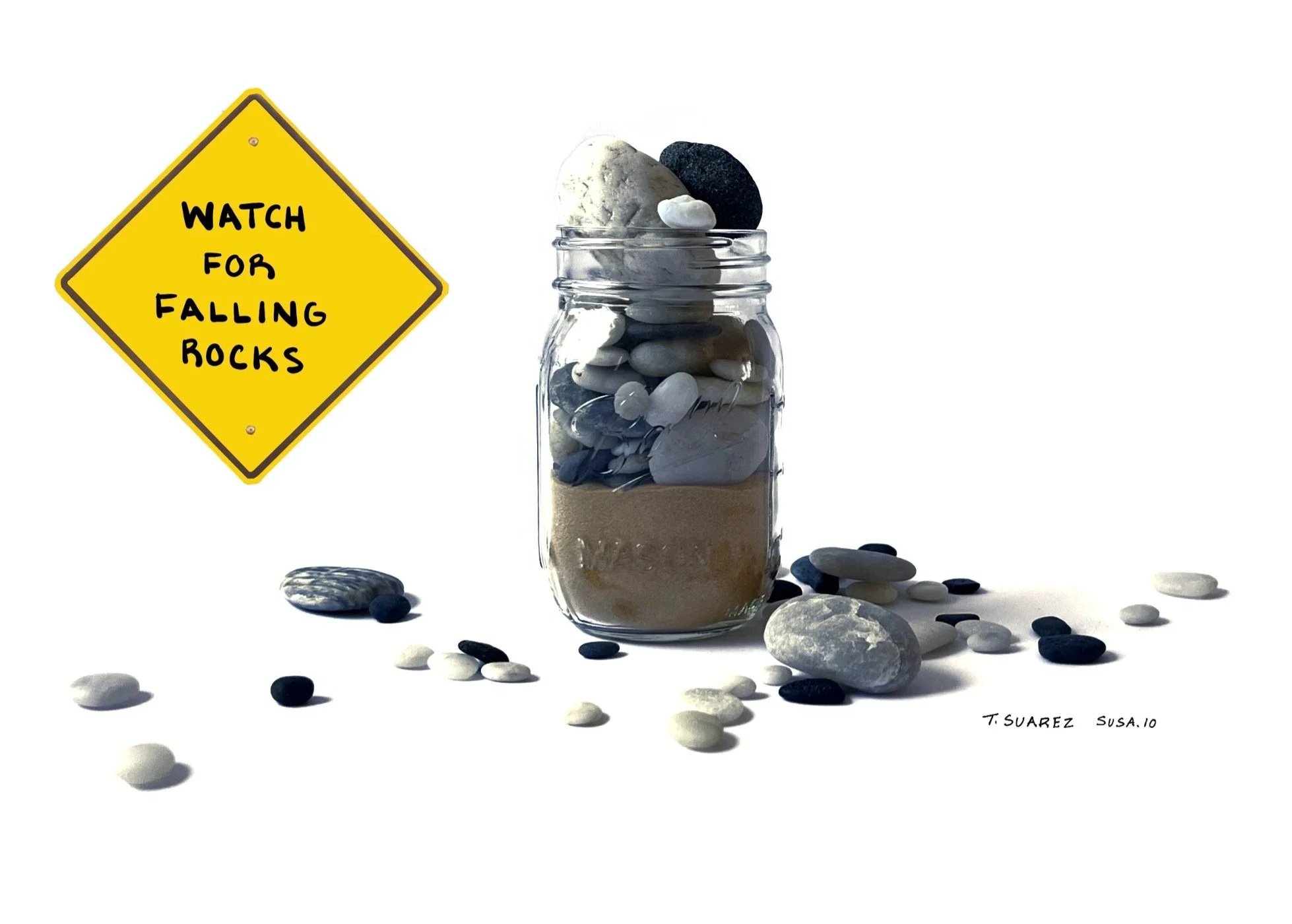
“Watch for Falling Rocks” - A cautionary warning often seen on road signs near rockfaces
Some of the best learnings come from failure. Good news is you can vicariously learn what not to do by observing failures and avoiding the painful pitfalls experienced firsthand by others.
Recently, I authored an article on “Big Rocks” which talks about the value of prioritizing what matters most, i.e., focusing on big rocks first, and avoiding having time consumed by “urgent” but “not important” matters. Many years of leading consulting engagements have given a plethora of real-world stories around the good, bad, and ugly of big rocks. This article is going to share a story from the consulting field that demonstrated what happens when people and teams fail to prioritize resources and consequently fail to accomplish any “big rocks.”
In the story of the “Buddy (B)-Team” flunking big rocks, their failure to demonstrate value inspired the introduction of Objectives Key Results (OKRs). The OKRs were designed to help align teams to work better together and make better use of their time towards activities that matter and add value. This OKR origin story will be retold in the following acts:
· Act 1: A Call for Help
· Act 2: Triaging the Situation
· Act 3: Identifying a Solution
· Closing Act: Teeing up OKRs
· Encore: SUSA Services
Act 1: A Call for Help
A storm was brewing for a delivery team. The B-Team was comprised of delivery consultants with full-time focus on a high-value account. One day, the B-Team’s lead executive and several team members approached me and asked for help. The blunt problem statement was: “The client does not see any value in our work; can you help us?”
To better orient around the situation, I asked the team to explain why the client might have this perspective. The team proceeded to explain that the client openly told the team that they “didn’t see what value the team provided,” and did not want to waste more time with them. This comment came after several months of troubling interactions including personality clashes, communication snafus, expectation mismatches, declined meetings, and finally no responsiveness from the client.
The team was hoping I could help remediate the situation by leveraging my rapport and facilitation skills to mediate the impasse.
Act 2: Triaging the Situation
After listening to the team express their pain points and frustrations, I could understand their concern. I empathized with their feeling demoralized, then switched into triage mode to help them better represent the value they were providing.
I asked the team to recount the top accomplishments for the past 3-6 months, key deliverables, key outcomes, etc. Each question I asked to determine value they delivered was met with a volley of verbose explanations about urgent demands, constant firefighting, and important matters consuming their time. Aside from excuses, the team was unable to reference any clear value delivered.
The quick back-and-forth triage helped me realize: if I am getting unclear and defensive responses to simple questions, I could only imagine what the client might have experienced. The team did not convey confidence or give any compelling examples of explicit value delivered.
Act 3: Identifying a Solution
Shifting the focus from triage to potential remediation paths, I suggested that the team explicitly recount their past 6 months, focusing on “big rock” items. Once finished, we could review the work and schedule a meeting to hear the client out and gain their perspective. I thought the summary of key rocks could help serve as a backdrop for the client to provide candid feedback and open communication channels again.
The team pushed back again to the idea of itemizing work. And restarted a carousel of excuses to avoid providing a clear answer.
A bit befuddled by the continual excuses, I candidly told the team that worst case, if they truly had no deliverables or outcomes to show for their 6 months of full-time work, then we would simply be transparent with the client: unplanned work and constant firefighting consumed their time. To fix this: they were taking steps to recalibrate activities and realign expectations so that communications could be better handled and time could be better managed going forward.
A senior consultant on the team balked at the idea and said: “But that would sound like we didn’t do anything for the last 6 months!” inferring that it would be a bad look for the team.
I remember thinking: considering we just spent an hour observing the excuse engine in full operation, without producing any clear cases for value, I could understand and commiserate with the pain of the client. The team needed to set measurable goals and execute them.
Closing. Act: Teeing up OKRs
“There are so many people working so hard and achieving so little.” – Andy Grove as quoted in Measure What Matters
To help the struggling B-Team better serve the client, I thought introducing OKRs to their work could help. I remember I was first introduced to OKRs fresh after graduate school; and I picked up John Doerr’s book Measure What Matters to do a deep dive and refresh on the method.
In that book, an ode was given to Andy Grove “The Father of OKRs,” God rest his soul. I thought the above line of Andy’s perfectly encapsulated the collective pain of the B-Team, client, and my own after interacting with the team. Hard work without clear achievements is frustrating. OKRs were his way of introducing a “very, very simple system” that could help teams work toward clear goals.
By helping the team define their goals, some rocks* were able to be chipped away at going forward, as opposed to sinking in the quicksand of constant firefighting and urgent but not necessarily important content.
*To be radically transparent, the team could not differentiate big rocks from small rocks, and sometimes sand. It took several hand-holding cycles to help define “rocks.” The team’s progress went from drowning in sand to piling up little rocks. If your team or organization adopts OKRs, keep in mind the learning curve and celebrate the small wins, including “small rocks.”
Encore: SUSA Services
Experiences of working with the B-Team showed “what not good looks like.” This helped inspire the way we approach services at SUSA: people-centric, performance-driven, and value-focused. We recognize that constant firefighting of cybersecurity teams can undermine morale, result in missed outcomes, frustrate surrounding stakeholders, and even lead to burnout.
Our culture and communication services help teams avoid the pitfalls of “working so hard and achieving so little” by helping teams define their purpose and build organizational operating systems that help load-balance demands on time and orchestrate communications. Connect with us at SUSA to learn more. We’d love to hear from you!
Comments
Loading comments…