


Big Rocks: Prioritize What Matters Most
This article is going to provide a “show and tell” walkthrough in the spirit of the thought exercise popularized by Stephen Covey, the author of The 7 Habits of Highly Effective People. While this exercise applies universally to individuals, it also applies particularly well to people in our current cybersecurity climate that includes a constantly changing landscape filled with noise and an overall overstimulating digital world.
It is hard to believe we are already a month into the new year. Time seems to fly by when you are having fun – or not paying attention to where it is spent. Since we are always bound by the constraints of finite resources, I think it’s important to intentionally and habitually prioritize what matters most to make the most of life. Put differently, it is important to begin with the end in mind and make space for our “Big Rocks” first.
I discovered the “Big Rocks” thought exercise years ago and added it to my mental model mindscape. Recently, I was surprised when someone I chatted with was unfamiliar with the “Big Rocks” reference. This conversation made me realize this timeless concept should make a comeback. It is a powerful paradigm that can help individuals both personally and professionally.
This article is going to provide a “show and tell” walkthrough in the spirit of the thought exercise popularized by Stephen Covey, the author of The 7 Habits of Highly Effective People. While this exercise applies universally to individuals, it also applies particularly well to people in our current cybersecurity climate that includes a constantly changing landscape filled with noise and an overall overstimulating digital world.
“Big Rocks” Thought Exercise
Imagine that you were given a cup with space for filling your time (e.g. 24 hours a day). Then imagine you had three piles of material to fill the cup with including: a pile of big rocks, small rocks, and sand. (ok, technically the rocks are ‘pebbles’ because I picked them at the beach).

Now imagine that each of the piles represented an ordering of value. Big rocks being the most important, sand being the least important, and small rocks being somewhere in-between. If you were to itemize areas and activities in your life, then categorize them into the buckets, it might look something like this:
· Big rocks
o Faith
o Family
o Relationships e.g., friends and work buddies
o Health
o Objectives Key Results (OKRs) at work
· Small rocks (pretty pebbles)
o Admin tasks
o Business as usual (BAU) at work e.g., status meetings
o BAU at home e.g., making bed, taking out trash etc.
o Hobbies
· Sand
o Pointless meetings and unplanned work
o Busywork like endless slacks, emails, alerts on phone
o Scrolling through social media
o Watching Netflix or YouTube
o Random GPT conversations or bot-inquiries*
*Check out the Reddit-like social networking websites for AI agents exchange with other AI agents. Some threads show that even AI Agents get tired of expending resources to compute nonsensical content requests for humans. Evidently, in this brave new world, even inanimate objects process “sand” as friction that clogs the system.
Scenario 1: Sand First, Rocks Next
When it comes to filling the cup, decisions need to be made on what goes in first. If your cup starts filling up with sand (e.g. busywork, scrolling, mind-numbing alerts and metrics, pointless meetings etc.), then adding the bigger and little rocks into the mix can result in items falling by the wayside. In the world of business, those missed rocks can be missed deadlines and missed objectives.

Scenario 2: Rocks First, Sand Last
Let’s now imagine that you proactively identify and articulate what matters most and then make time in your schedule (time-blocking is great for this) to ensure it happens. You prioritize big rocks first, then sprinkle in the little rocks which fill the crevices between the big rocks:

And, space permitting, all the least important items (sand) can fill the remaining space between:

Amazing. The same space can contain so much more with proper organization, prioritization, and execution! As you can see in the picture, our same cup is able to contain all of our rocks (big and small) and our sand without overflowing.
Making Space for What Matters
Things which matter most must never be at the mercy of things which matter least. – Goethe
Steven Covey also adds other dimension beyond important and not important: urgent and not urgent and then places into a model known as the Time Management Matrix. This gives another powerful schema for evaluating what matters and what does not matter, then planning and acting accordingly.
Let’s add some cybersecurity-specific context to help illustrate this paradigm:
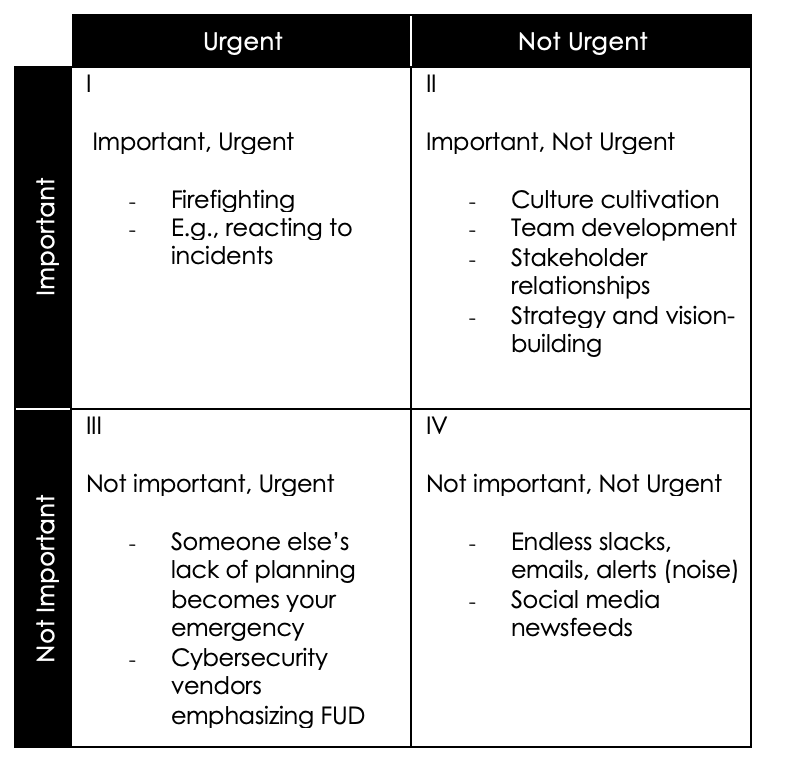
For your own thought exercise, try examining where your time, or your team’s time, is spent on a given day or work week and create an inventory.
· Are you and your teams in constant firefighting mode? (which can lead to burnout)
· Is your security organization in a constant reactive state?
· Is your calendar being overridden with “urgent” requests due to someone else’s lack of planning becoming your emergency?
· Are you experiencing alert fatigue due to endless slacks, emails, and meaningless metrics?
If you find your time is being commandeered by quadrant I and III, or clogged with IV, then maybe it is time to get help and reevaluate where your time is spent so you can claim your life back!
Rock Solid Closing Thoughts
“Time is the scarcest resource and unless it is managed nothing else can be managed.” Peter Drucker
At SUSA, we believe it is paramount for cybersecurity teams to position their finite resources well so they can fully actualize their agency and efficacy.
Our services help address the mess of urgent and not important items that hinder prioritization of important matters. A culture that values time management and focuses on true prioritization is able to accomplish more with less. By using our security knowledge and interdisciplinary experience-base, we look to empower clients with an organizational operating rhythm that orchestrates stakeholders and priorities in a way that optimizes the limited resources and load balances of workloads.
Ready to think differently about your time? Connect with us at SUSA!
Comments
Loading comments…