

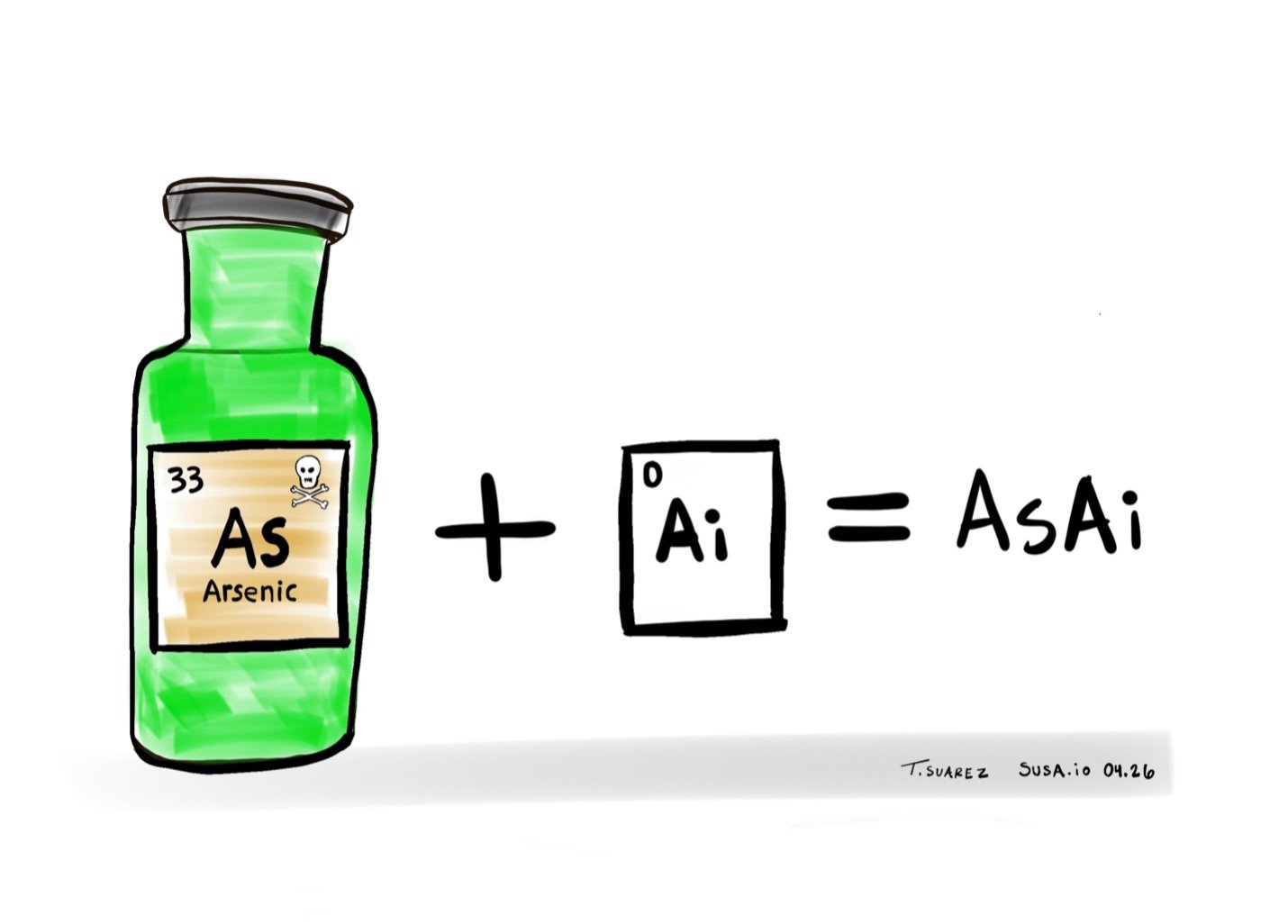
Arsenic and AI
AI has spread like wildfire across both the technology landscape and the mindscape of organizational decision-makers. While advances in Agentic AI commoditize magic-like powers unlike ever before, there may be some toxic-strings-attached to this newfound power. I discovered some terminal traits through firsthand experience with building agents.
Yes, this article is coupling the notoriously toxic periodic element arsenic with the contagiously adopted technology: Generative AI. The logic extends to AGI as well.
AI has spread like wildfire across both the technology landscape and the mindscape of organizational decision-makers. While advances in Agentic AI commoditize magic-like powers unlike ever before, there may be some toxic-strings-attached to this newfound power. I discovered some terminal traits through firsthand experience with building agents.
This article is going to share some observations from a Generative AI and Digital Transformation course I completed recently. During this course, I was able to explore the top LLMs side-by-side and build out digital agents and stress-tested the ability to replace specific team activities for strategic purposes. Two cases inspired by real world situations, along with the resulting exciting and unsettling findings, will be shared below.
Case 1: Fast and Fantastic Change Management Content
Observation
A change management team took months to conduct discovery, draft personas, and craft mediocre communications. Since effective change management can help or hinder the successful adoption and implementation of organizational change, the speed and quality of content creation is a precursor to success. A change team change was desperately needed (ironic, I know).
Hypothesis to test
Could a digital agent expedite a change management team’s content creation activities to free up time for focusing on relationship development?
Findings
Exciting part: In a handful of steps, beginning with methodically tailored prompts to build a digital change management agent, followed by a tightly structured set of instructions to build content, I was able to produce comparable (arguably better) change management content than the output of 100s of hours of team time spent over the course of months. And the agent-build and prompts-to-outputs were not even half-a-day’s work! Imagine if that time spent drafting content was instead spent socializing and refining content with relevant stakeholders!
Unsettling part: This made me realize that Agentic AI can have an arsenic-like effect on current consulting services and eliminate teams. Mediocre teams will not fare well in the age of Agentic AI. People will be forced to shape up or shape out.
Case 2: Strategy with Strings-Attached
Observation
Non-domain-knowledgeable consultants leverage AI to provide domain-knowledge-specific strategic content.
Hypothesis to test:
Could domain-knowledge-gaps lead to problematic gaps in strategy and tactics?
Findings
Exciting part: Like the change management agent-build and agent-prompting process, it only took a few steps to create a whole array of impressive-looking “strategic” cybersecurity content. In the consulting world before Agentic AI, it would have taken days/weeks of consulting time and $$$$$ to create commensurate content. Also, the outputs were more logical, compelling, and contextually astute than content I’ve seen produced by management consultants in the past.
Unsettling part: Generative-AI is going to be the new consulting crack that management consulting leadership will love perhaps even more than they loved merely superficial PPT-jockey content. And that can come with troubling side effects.
I noticed a reoccurring trend with the LLM outputs. I intentionally had the agents produce content in areas that are within my field of expertise, where I have read countless books and gained real-world insight from firsthand learning. As I would conduct a line-by-line review of the LLM output, I would take note of any inaccurate data, or “hallucinations” as AI-semantics-savvy people would say.
The outputs were roughly 85 to 99% accurate; but they often included anywhere from 1 to 15 % of straight up inaccurate content. And since all outputs appear equal, it was only through my judgment that I could flag the lack of data integrity. Imagine if a person did not have the ability to fact-check! The only reason I could discern inaccurate nuances is because I invested years of continuous learning to build a deep knowledgebase.
An inaccurate data output trend was seen across the class of 50+ students in their respective exercises with varying degrees of accuracy e.g. one classmate built an agent to write his resumé and flagged that the output based on an internet crawl gave him sports awards and academic accolades that were not true, even though they appeared to be great. But the rest of the resumé looked more than “good enough.”
Call to Action: Watch Your Cup
The dose that makes the poison – well-known toxicology trope
Aside from the clear-cut existential threat to teams being rendered obsolete and replaced by digital agents that can collapse months of full-time consulting work into hours/minutes and produce a comparable (or even better) outputs, there are some subtler concerns.
Just as habits are the output of repeated actions, thoughts are the product of what fills your mind and informs decisions. If LLM outputs are primary feeds to your mind, team, communications, and forms your organizational strategy… then you may be consuming trace dosages of “Arsenic AI” (AsAi) that will amass over time. Said figuratively, you may be drinking a cup of arsenic-laced-AI. And that may lead to a fast or slow poisoning of the well of your mind, work product, and overall environment.
While AI is a powerful and intoxicating drink, it is important to “watch your cup” and drink responsibly.
At SUSA, we help organizations think critically about cybersecurity strategy by conducting design-thinking and coaching services that bring systems-thinking to balance the power of technology and the power of people. We recognize the creative tension between human intelligence and artificial intelligence and believe human intelligence can be augmented and complemented with AI but must prevail as paramount.
Connect with us to learn more about how we leverage co-creation sessions to spark creative tension and co-create a vision that cultivates healthy organizational habits.
*Note: the inspiration for this article framing came from an absurd old movie called Arsenic and Old Lace. It is a bizarre story that includes well-intentioned people leveraging arsenic with fatal outcomes and somehow that made me think of unchecked AI usage and consumption.
Comments
Loading comments…